
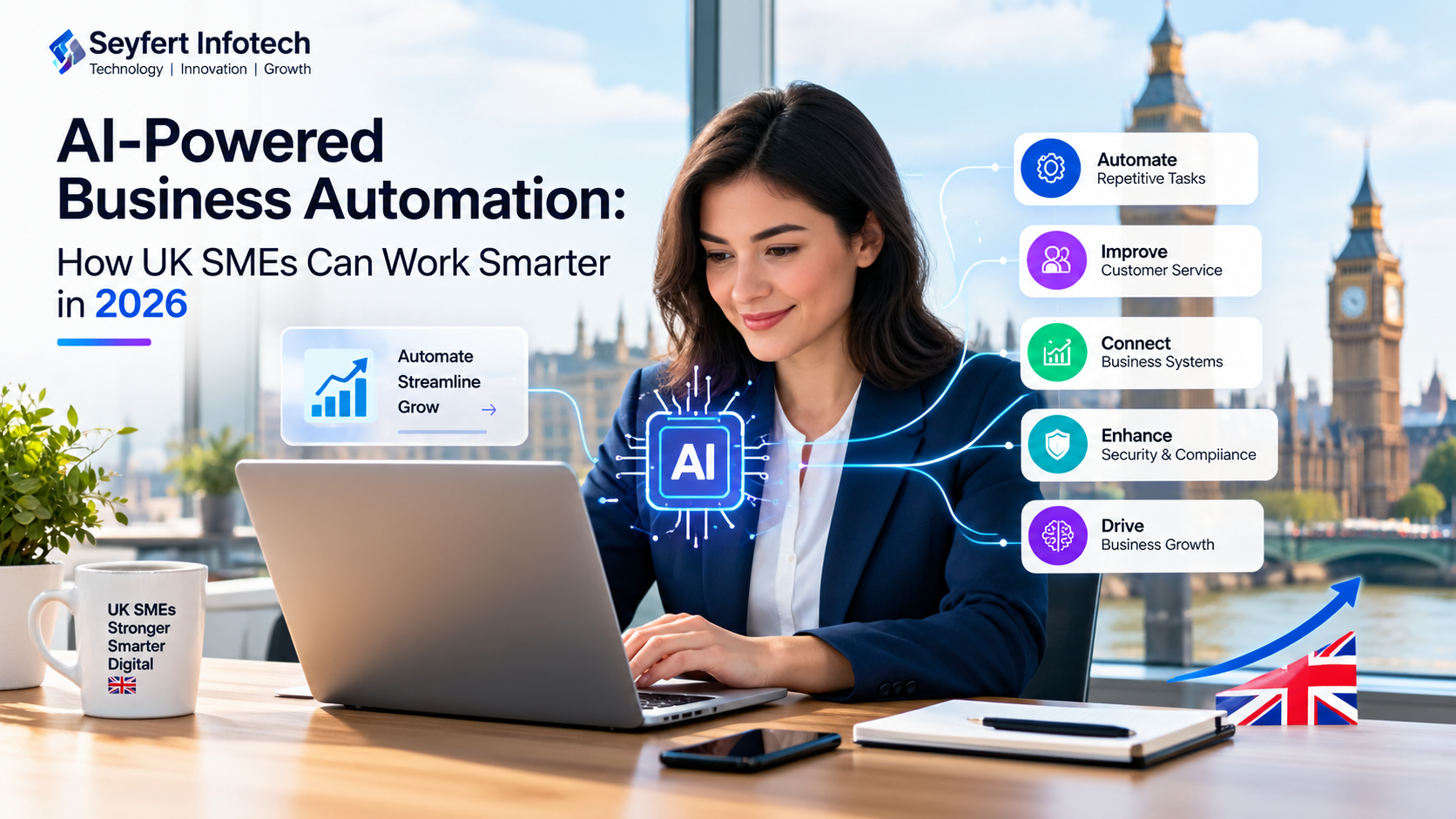
“Business automation is moving from a specialised technology initiative to a practical way for organisations to improve everyday operations. For UK small and medium-sized businesses, automation can help reduce repetitive administrative work, improve consistency, speed up customer responses and give teams more time to focus on higher-value activities. Artificial intelligence is also becoming increasingly relevant to UK businesses. According to the Office for National Statistics, self-reported AI use among UK businesses with 10 or more employees increased from around 12% in late 2023 to around 35% in June 2026. :contentReference[oaicite:1]{index=1} The opportunity for SMEs is not simply to adopt AI because it is new. It is to identify practical business processes where automation can create measurable value.”
Why Business Automation Matters for UK SMEs in 2026
Business automation is moving from a specialised technology initiative to a practical way for organisations to improve everyday operations. For UK small and medium-sized businesses, automation can help reduce repetitive administrative work, improve consistency, speed up customer responses and give teams more time to focus on higher-value activities. Artificial intelligence is also becoming increasingly relevant to UK businesses. According to the Office for National Statistics, self-reported AI use among UK businesses with 10 or more employees increased from around 12% in late 2023 to around 35% in June 2026. :contentReference[oaicite:1]{index=1} The opportunity for SMEs is not simply to adopt AI because it is new. It is to identify practical business processes where automation can create measurable value.
What Is AI-Powered Business Automation?
AI-powered business automation combines traditional workflow automation with artificial intelligence. Traditional automation follows predefined rules. AI-powered automation can additionally analyse information, classify requests, generate responses, identify patterns and support decisions within defined business processes. For example, an automated workflow could receive a customer enquiry, identify the type of request, send the appropriate information, create a CRM record and notify the relevant team member. The exact level of automation should depend on the business process, available data, security requirements and the level of human oversight required.
1. Automate Repetitive Administrative Tasks
Many businesses spend significant amounts of time on repetitive activities such as data entry, email processing, document handling, appointment management and internal notifications. Automation can connect these processes so that information moves between systems with less manual intervention. For an SME, even small improvements across multiple workflows can reduce operational friction. The first step is to identify repetitive processes that follow predictable patterns and determine whether automation can safely handle part or all of the workflow.
2. Improve Customer Enquiry Management
Customer enquiries can arrive through websites, email, social media, forms and other communication channels. Without a structured process, enquiries can be missed, delayed or assigned incorrectly. An automated enquiry workflow can capture customer information, categorise the request, create a CRM record, send an acknowledgement and alert the appropriate team. AI can also help classify enquiries or identify the likely intent of a customer message, while human staff remain responsible for cases that require judgement or specialist attention.
3. Connect Business Systems
Automation becomes more powerful when business systems can communicate with one another. A website, CRM, accounting platform, email system, booking platform and internal application may each contain useful information. Without integration, employees may need to move information manually between these systems. APIs and workflow automation can help connect these platforms so that information flows more efficiently. The result can be a more connected digital operation with fewer repetitive manual steps.
4. Use AI to Support Customer Service
AI can support customer service by helping businesses handle common questions, organise information and provide faster responses. AI-powered assistants can be connected to approved business information so that customers can access relevant answers without waiting for a member of staff. However, automated customer service should have clear boundaries. Complex, sensitive or unusual requests may require human involvement. A good automation strategy therefore combines automation for routine interactions with human support when judgement is required.
5. Automate Sales and Lead Follow-Up
Lead follow-up is another area where automation can support business growth. When a prospective customer submits an enquiry, an automated workflow can record the lead, send an acknowledgement, notify the sales team and schedule appropriate follow-up activities. Businesses can also use automation to segment leads based on their requirements or engagement. The purpose is not to replace the sales relationship. It is to ensure that opportunities are organised and that important follow-up actions are less likely to be missed.
6. Make Data More Useful
Modern businesses generate information across websites, CRM systems, sales platforms, marketing channels and operational tools. Automation can help collect and organise this information. AI can then support tasks such as summarisation, classification, pattern recognition and reporting. The UK Business Data Survey 2026 found that 86% of UK businesses handled digitised data in 2025 to 2026. Among businesses handling digitised data, 41% reported using AI for at least one purpose. :contentReference[oaicite:2]{index=2} Better-connected data can therefore provide a foundation for more informed business processes.
7. Improve Internal Workflow Management
Automation is not limited to customer-facing activities. Internal processes such as employee onboarding, approval workflows, task assignments, reporting and document management can also be automated. For example, when a new employee joins an organisation, an automated workflow could create required accounts, notify relevant departments and generate onboarding tasks. Small process improvements can make internal operations more consistent and reduce unnecessary administrative work.
8. Build Automation Around Real Business Problems
Successful automation starts with the process rather than the technology. Businesses should first identify where time is being spent, where errors occur, where customers experience delays and where information has to be entered repeatedly. Once the problem is understood, the organisation can determine whether workflow automation, AI, software integration or a combination of technologies is appropriate. This approach prevents businesses from adopting technology without a clear operational purpose.
9. Security and Responsible AI Adoption
Automation can involve customer information, financial records, internal documents and other business data. Security therefore needs to be considered before an automated workflow is implemented. Businesses should evaluate data access, authentication, permissions, API security, information storage, third-party services and human oversight. AI adoption should also be appropriate to the sensitivity of the information being processed. The UK's current SME digital adoption work specifically identifies capability, cost and awareness as barriers to technology adoption, while government initiatives are focused on helping SMEs build digital and AI capability. :contentReference[oaicite:3]{index=3}
10. Keep Humans in the Loop
Not every business decision should be automated. Processes involving sensitive information, significant financial consequences, compliance requirements or complex customer situations may require human review. A well-designed automation system can therefore combine automated processing with approval stages. This creates a practical balance between efficiency and human oversight.
How UK SMEs Can Start With Business Automation
Businesses do not need to automate everything at once. A practical starting point is to choose one repetitive process that has a clear business impact. For example, a company could begin with website enquiry management, appointment reminders, CRM updates or internal reporting. After measuring the results, the organisation can identify additional processes that may benefit from automation. Starting small can make it easier to understand the technology, train employees and establish appropriate controls before expanding automation across the organisation.
AI Adoption Is Becoming Part of the UK Business Conversation
AI adoption is now receiving significant attention across the UK business environment. The UK Government's SME Digital Adoption Taskforce has set an ambition for UK SMEs to become highly digitally capable and AI confident, while its 2026 update outlines ongoing work to address barriers to digital technology adoption. :contentReference[oaicite:4]{index=4} The Office for National Statistics also reports that AI adoption varies considerably by business size and sector, showing that businesses are progressing at different levels of digital maturity. :contentReference[oaicite:5]{index=5} For SMEs, this means there is no single automation strategy that works for every organisation. The right approach depends on business objectives, processes, data, technology and customer requirements.
Business Automation vs Traditional Software
Traditional business software usually provides specific functionality such as accounting, CRM, inventory management or project management. Automation connects these capabilities and allows information to move between them according to defined workflows. AI adds another layer by helping systems interpret information, generate content, classify requests or identify patterns. Together, software, integration and AI can create a more connected digital operating environment.
The Future of Business Automation for UK SMEs
Business automation is likely to become increasingly connected with AI, cloud platforms, analytics and business software. The focus will move beyond simple task automation towards more intelligent workflows that can understand information, recommend actions and support employees. However, effective automation will continue to depend on good processes, reliable data, appropriate technology and clear governance. Technology can provide the capability, but businesses still need a clear strategy for how that capability should be used.
How Seyfert Infotech Can Help UK Businesses
Seyfert Infotech helps businesses build connected digital solutions through business automation, website development, mobile applications, custom software and digital marketing. Our approach begins by understanding the business process and identifying opportunities where technology can improve efficiency, customer experience or information flow. From automated workflows and system integrations to custom digital platforms, solutions can be designed around the specific requirements of the organisation.
Final Thoughts
AI-powered business automation can give UK SMEs new ways to improve everyday operations, strengthen customer experiences and make better use of digital information. The goal should not be to automate every task. Instead, businesses should identify repetitive or inefficient processes where technology can create meaningful improvements. By combining automation, AI, software integration, data and human expertise, UK businesses can build digital operations that are more connected, efficient and adaptable. For SMEs planning their next stage of digital growth, automation can be a practical starting point for turning technology investment into measurable business improvements.
What is business automation?
Business automation uses software and digital workflows to perform repetitive business processes with less manual intervention. It can support areas such as lead management, customer communication, reporting, administration and system integration.
How can AI help UK SMEs?
AI can help SMEs with tasks such as information processing, customer support, content generation, data analysis, classification and workflow assistance. The appropriate use depends on the business process, data and objectives.
Is business automation suitable for small businesses?
Yes. Small businesses can start with individual workflows where automation can reduce repetitive work or improve consistency. The scope can then expand as the business gains experience with automation.