
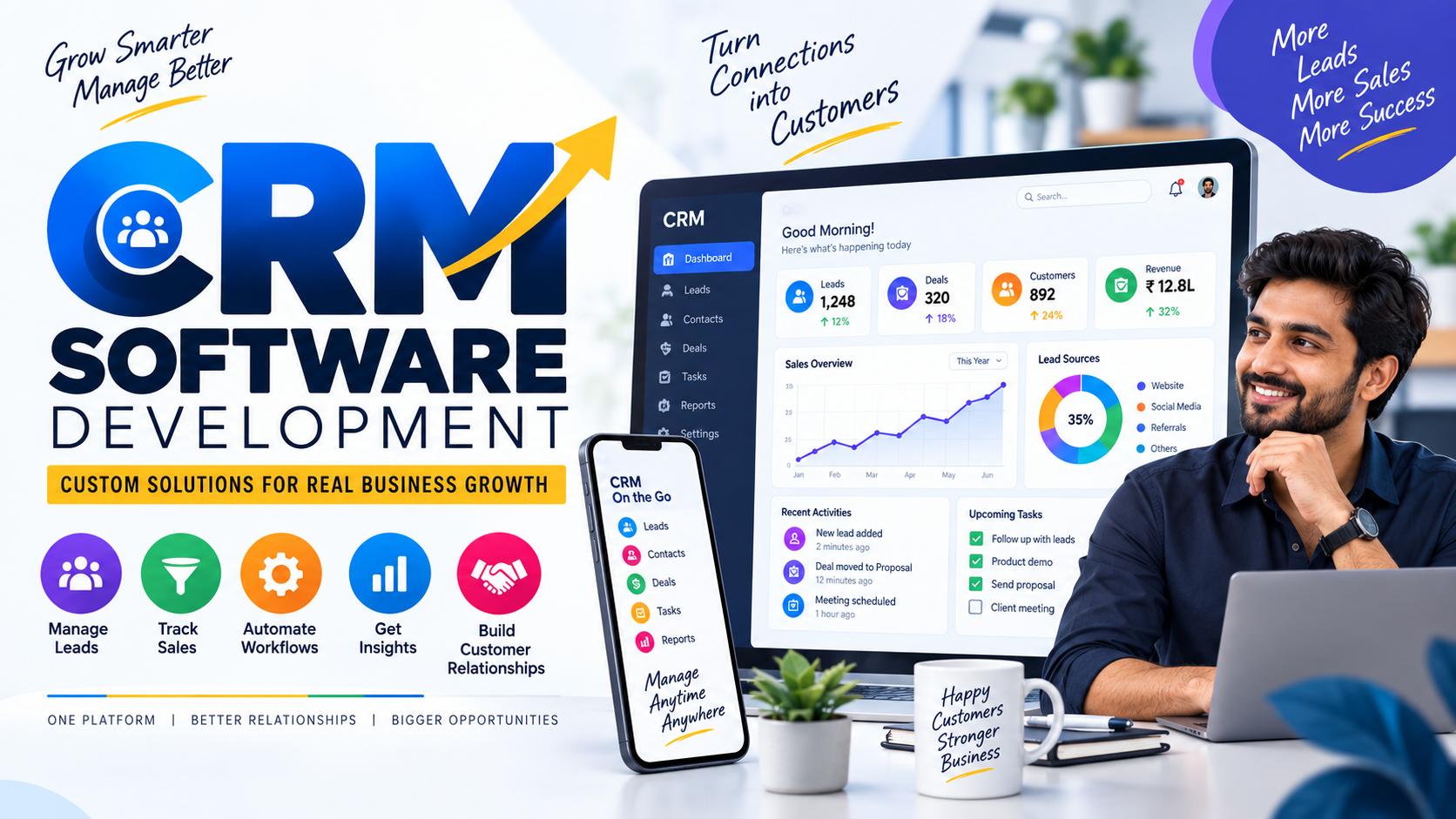
“Managing customer relationships becomes more complex as a business grows. Leads may arrive through websites, calls, social media, advertisements, referrals, and multiple sales channels, making manual tracking difficult. CRM software development in India helps businesses organize customer information, sales activities, enquiries, follow-ups, and communication within a centralized digital platform.”
Why Businesses Need CRM Software Development in India
Managing customer relationships becomes more complex as a business grows. Leads may arrive through websites, calls, social media, advertisements, referrals, and multiple sales channels, making manual tracking difficult. CRM software development in India helps businesses organize customer information, sales activities, enquiries, follow-ups, and communication within a centralized digital platform.
A customized CRM gives sales and service teams quick access to customer history, lead status, previous interactions, and upcoming activities. This creates a more organized workflow and reduces the possibility of important opportunities being missed. Businesses can also configure the CRM according to their existing processes instead of completely changing their workflow to match generic software.
Custom CRM Software Development for Business Requirements
CRM Solutions Designed Around Your Workflow
Every organization follows a different process for generating leads, communicating with customers, closing sales, and providing after-sales support. A custom CRM can be developed according to these specific requirements. Custom CRM software development allows businesses to define sales stages, user roles, customer fields, approval processes, follow-up activities, and reporting requirements based on actual operations.
The platform can also evolve when new departments, services, locations, or sales processes are introduced. This scalability makes customized CRM solutions suitable for growing businesses and established organizations. A properly planned CRM creates a single source of customer information that authorized employees can access whenever required.
Lead Management and Sales Pipeline Automation
Effective lead management is one of the primary functions of a CRM platform. Businesses can capture enquiries, assign leads to sales representatives, update lead status, schedule follow-ups, and monitor progress from a centralized dashboard. CRM software helps teams understand where every opportunity is positioned within the sales pipeline and which leads require immediate attention.
Sales automation can reduce repetitive activities such as assigning enquiries, creating reminders, updating stages, and scheduling routine follow-ups. Automated workflows should be configured according to the organization’s actual sales process. Better lead visibility allows managers to understand sales activity while helping teams maintain consistent communication with potential customers.
Customer Data Management with Custom CRM Software
Customer information can become scattered across spreadsheets, emails, messages, notebooks, and different software systems. A centralized CRM helps businesses maintain organized customer profiles and interaction histories. Authorized employees can access contact information, previous enquiries, sales activity, notes, service requests, and other relevant customer details from a single platform.
Centralized customer information can improve coordination between sales, marketing, support, and management teams. Appropriate access controls can also be configured so employees only see information relevant to their responsibilities. Reliable customer records support more informed communication and help businesses provide a consistent experience throughout the customer lifecycle.
CRM Software with WhatsApp and Communication Integration
Customers communicate with businesses through multiple channels, and CRM integration can help teams manage these interactions more efficiently. Depending on the services and APIs being used, CRM platforms can connect with communication tools such as email, messaging, and calling systems. For businesses using supported WhatsApp business integrations, relevant conversations and lead activities can be connected with customer records and sales workflows.
Communication integration helps teams maintain better context when responding to enquiries and following up with prospects. It can also reduce the need to switch repeatedly between separate business applications. The exact features available depend on the communication provider, API permissions, business requirements, and CRM architecture.
CRM Dashboards and Business Reporting Solutions
A CRM dashboard provides management teams with an organized view of important sales and customer information. Businesses can track leads, opportunities, follow-up activities, conversions, team performance, and other relevant operational metrics. Custom reports can be developed according to the information required by sales managers, administrators, and business owners.
Instead of manually combining information from multiple spreadsheets, CRM reporting can present relevant business data within centralized dashboards. Accurate reporting helps organizations understand their sales processes, identify operational gaps, and make decisions using available business data.
AI-Powered CRM Software and Intelligent Automation
Artificial intelligence can enhance CRM software when applied to suitable business processes. AI features may support customer enquiry classification, intelligent search, content assistance, lead analysis, summaries, and other workflow-based use cases. The appropriate AI functionality depends on available data, business objectives, privacy requirements, and how employees will use the system.
AI should support employees rather than introduce unnecessary complexity into everyday CRM operations. Combining practical automation with human review can help businesses create more efficient customer management processes. A custom CRM development team can evaluate where AI features provide meaningful value before integrating them into the platform.
Cloud-Based CRM Software Development in India
Cloud-based CRM systems allow authorized teams to access business information through internet-connected devices without relying entirely on a single office computer. This approach can support organizations with multiple branches, remote employees, field sales teams, and distributed business operations.
Cloud CRM development can include secure authentication, user permissions, backups, API connectivity, activity tracking, and scalable infrastructure according to project requirements. Security, access management, data protection, and infrastructure planning should remain important considerations throughout CRM development.
Mobile CRM Solutions for Sales and Field Teams
Sales representatives and field employees often need access to customer information while working outside the office. Mobile CRM solutions can provide relevant customer records, lead updates, follow-up schedules, and sales information through smartphones. A responsive CRM interface or dedicated mobile application can be developed depending on the organization’s workflow and technical requirements.
Mobile access allows authorized employees to update customer information and sales activity closer to the point where interactions occur. When connected with the central CRM database, these updates can help office and field teams work with more consistent information.
CRM Software Development for Different Industries
CRM software can support businesses across real estate, healthcare, education, manufacturing, retail, hospitality, finance, technology, logistics, and professional services. Each industry has different customer journeys, enquiry processes, sales stages, service requirements, and reporting needs that can be addressed through customization.
An industry-focused CRM can include workflows and modules relevant to the organization instead of filling the platform with unnecessary features. Understanding business operations before development helps create a CRM that employees can use effectively in their everyday work.
SEO AEO and GEO for Public CRM Solution Pages
Companies providing CRM software services can strengthen the discoverability of their public website pages through SEO, Answer Engine Optimization, and Generative Engine Optimization practices. SEO supports traditional search visibility, while AEO focuses on answering customer questions clearly and GEO focuses on improving content for emerging AI-assisted discovery experiences.
Clear service descriptions, useful FAQs, structured information, strong technical performance, and relevant business details can make public CRM pages easier for people and search systems to understand. These practices should complement useful content rather than relying on keyword repetition alone.
Choosing a CRM Software Development Company in India
Choosing the right CRM development partner requires more than comparing software features. Businesses should consider technical expertise, understanding of workflows, security practices, integration capabilities, testing, documentation, and post-development support. A professional development team should understand existing sales and customer management processes before designing the CRM architecture.
Businesses should also consider future scalability because CRM requirements may change as teams, customer volumes, locations, and services expand. A flexible architecture makes it easier to introduce additional modules and integrations when genuine business requirements arise.
A custom CRM brings leads, customer information, follow-ups, sales activities, communication, and reporting into a connected business platform. The right CRM solution can reduce fragmented processes and give teams a clearer way to manage customer relationships from initial enquiry through ongoing service.
Frequently Asked Questions About CRM Software Development
What is custom CRM software development?
Custom CRM software development involves creating a customer relationship management platform according to a business’s specific sales processes, customer workflows, user roles, integrations, and reporting requirements.
How much does CRM software development cost in India?
CRM development cost depends on required modules, number of user roles, integrations, automation, mobile access, reporting, security requirements, and overall project complexity. Detailed requirements are normally needed for a meaningful estimate.
Can CRM software integrate with existing business applications?
Yes, custom CRM software can integrate with compatible business applications through available APIs and other supported integration methods. The possibilities depend on the existing system, provider permissions, technical architecture, and business requirements.
Can CRM software be customized as a business grows?
Yes. A properly designed custom CRM can be expanded with additional modules, users, workflows, reports, and integrations as business requirements change. Planning for scalability during development makes future improvements easier.