
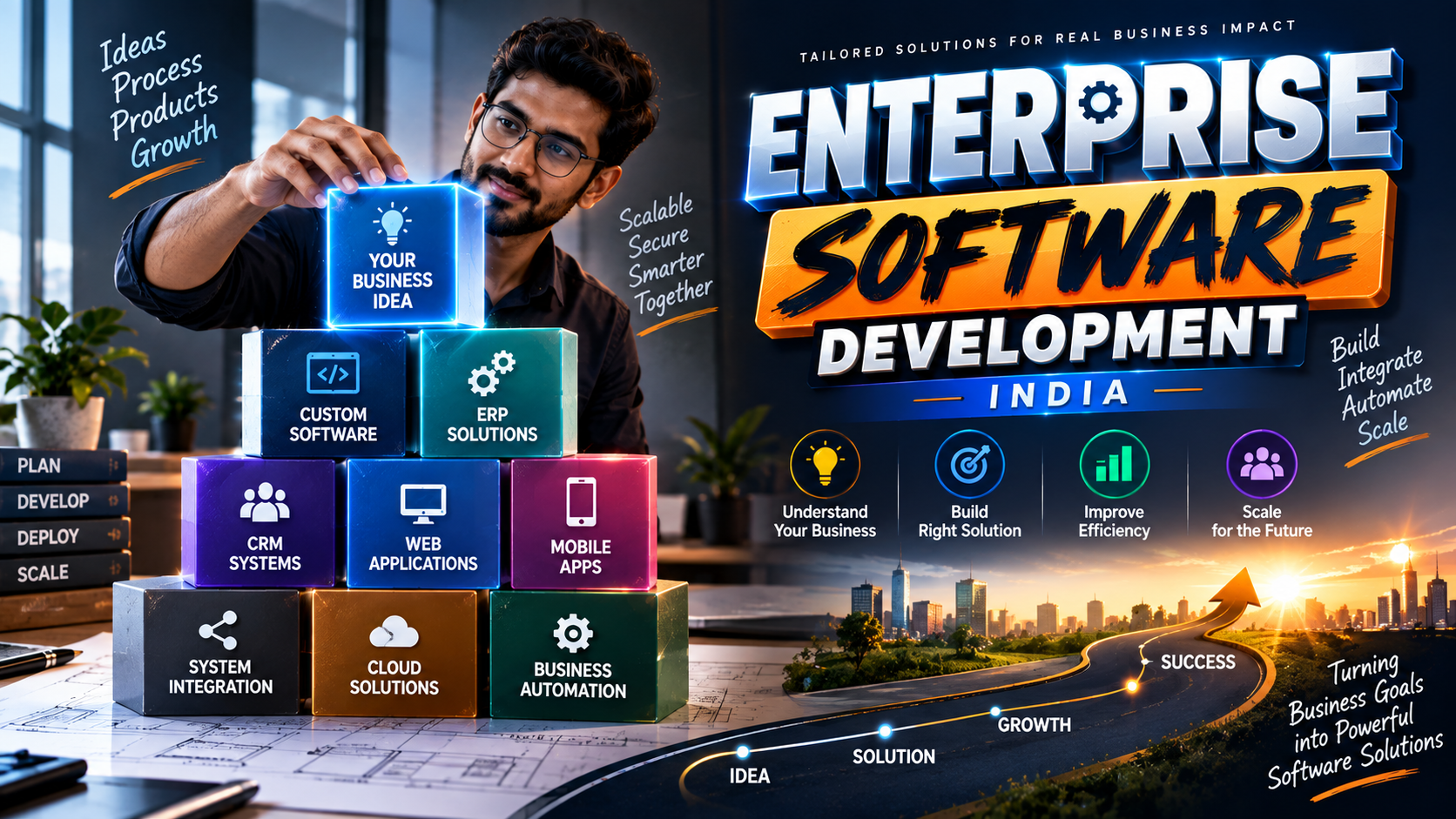
“Large and growing organizations often manage complex processes across sales, finance, operations, customer service, inventory, human resources, and management. Using disconnected applications and spreadsheets can make information difficult to manage as business operations expand. Enterprise software development in India helps organizations create centralized systems that connect important processes, departments, users, and business data within a structured digital environment.”
Why Businesses Need Enterprise Software Development in India
Large and growing organizations often manage complex processes across sales, finance, operations, customer service, inventory, human resources, and management. Using disconnected applications and spreadsheets can make information difficult to manage as business operations expand. Enterprise software development in India helps organizations create centralized systems that connect important processes, departments, users, and business data within a structured digital environment.
Enterprise applications can be designed around an organization’s existing workflow instead of forcing every department to depend on generic software processes. This allows businesses to define user roles, approvals, reporting structures, integrations, and operational rules according to their requirements. A scalable architecture can also support additional users, modules, branches, and integrations as the organization grows.
Custom Enterprise Software Development Services
Software Solutions Designed Around Business Operations
Every enterprise has different operational requirements depending on its industry, organizational structure, customer journey, and internal processes. Custom enterprise software development begins by analyzing these requirements before selecting technologies or designing application modules. The resulting software can support specific workflows, departments, permissions, reporting requirements, and integrations rather than providing unnecessary generic features.
Custom development also gives organizations greater flexibility when existing processes change. New modules and capabilities can be introduced according to future requirements when the software architecture has been planned for expansion. This approach makes enterprise applications more adaptable to long-term digital transformation initiatives.
Enterprise ERP Software Development Solutions
Enterprise Resource Planning software connects important operational functions within a centralized business system. Depending on organizational requirements, an ERP platform can support finance, purchasing, inventory, sales, production, human resources, and other internal processes. Centralizing these workflows can reduce fragmented information and provide authorized teams with more consistent access to operational data.
Custom ERP software can be configured according to specific approval processes, reporting structures, departments, and business rules. Organizations can implement relevant modules rather than adopting functionality that provides little operational value. ERP development should also consider security, scalability, integration requirements, data migration, and employee usability.
Enterprise CRM Software Development
Large organizations often manage customer relationships across multiple sales teams, branches, communication channels, and service departments. Enterprise CRM software can centralize leads, customer records, sales opportunities, follow-ups, communication histories, and related activities. Role-based access can help different departments work with relevant customer information while maintaining appropriate controls over business data.
Enterprise CRM solutions can also integrate with compatible websites, applications, communication platforms, ERP systems, and other business tools through supported APIs. These integrations can create more connected workflows between customer acquisition, sales management, service operations, and business reporting.
Business Process Automation for Enterprises
Large organizations often perform repetitive processes involving approvals, notifications, assignments, document movement, reporting, and data entry. Enterprise software can automate appropriate parts of these workflows according to predefined business rules. Automation can help reduce unnecessary manual activities while creating more consistent processes across departments and operational teams.
Not every business decision should be completely automated, particularly when human judgment or approval is required. Effective workflow design identifies which activities can be automated and which should remain under employee supervision. This balanced approach can improve operational efficiency without introducing unnecessary complexity into critical business processes.
Cloud-Based Enterprise Software Development
Cloud-based enterprise applications can provide authorized users with access to business systems across supported locations and devices. This can benefit organizations operating multiple offices, branches, remote teams, or distributed operations. Cloud architecture can also provide infrastructure flexibility when application usage and business requirements change over time.
Enterprise cloud development requires careful consideration of availability, backups, access controls, monitoring, application security, and infrastructure architecture. Organizations should select deployment models according to their technical requirements, regulatory responsibilities, data policies, and operational priorities rather than treating cloud adoption as a universal solution.
Enterprise Web Application Development
Modern enterprise web applications can support internal administration, customer portals, employee systems, reporting dashboards, inventory platforms, workflow management, and numerous other business requirements. Responsive web applications allow authorized users to access relevant functionality through supported browsers without requiring separate desktop software for every workflow.
Enterprise web application development should focus on usability, security, maintainability, performance, and scalable architecture. The interface should remain practical even when the application contains large amounts of business information and functionality. Clear navigation and role-based dashboards can help employees access the tools and information relevant to their responsibilities.
Enterprise Mobile Application Development
Mobile enterprise applications can support employees who need access to business information while working away from traditional office environments. Field sales teams, service engineers, delivery staff, managers, and other authorized users may benefit from mobile access. Applications can provide suitable features such as task updates, customer information, approvals, reports, service records, or other workflow-specific functionality.
Enterprise mobile development should consider device security, authentication, network availability, permissions, and the sensitivity of information being accessed. Mobile functionality should focus on genuine operational requirements instead of attempting to reproduce every desktop feature on a smaller screen.
AI Integration in Enterprise Software Solutions
Artificial intelligence can enhance selected enterprise workflows when implemented around clearly defined business requirements. AI capabilities may support document processing, information retrieval, customer assistance, classification, summaries, analytics, and other appropriate use cases. The value of AI depends heavily on available data, process design, accuracy requirements, privacy considerations, and how employees interact with the system.
AI-generated outputs may require validation or human review depending on their purpose and business impact. Enterprise AI implementations should therefore include appropriate controls, permissions, testing, and monitoring. Integrating AI thoughtfully can support employees and automation while keeping important business decisions within suitable governance processes.
Enterprise Software Integration and API Development
Organizations often depend on multiple applications for finance, sales, communication, logistics, payments, customer management, and other operations. Enterprise software integration can connect compatible systems and allow permitted information to move between applications. APIs and supported integration methods can reduce repeated manual data entry and create more connected workflows across different business platforms.
Integration planning should consider authentication, data formats, error handling, synchronization, permissions, and the capabilities of third-party systems. A reliable integration architecture helps organizations expand their technology ecosystem without unnecessarily rebuilding every existing business application.
Enterprise Software Security and Access Management
Enterprise applications can contain important customer, employee, financial, and operational information, making security an essential development consideration. Authentication, authorization, encryption, secure development practices, backups, and activity monitoring may form part of the security architecture. Role-based access controls can help ensure users only access features and information appropriate to their responsibilities.
Security requirements should be evaluated throughout planning, development, testing, deployment, and maintenance rather than being added only at the end of a project. Organizations may also need additional controls depending on their industry, applicable regulations, internal policies, and the sensitivity of information processed by the application.
Scalable Architecture for Growing Enterprises
Enterprise software should be designed with future requirements in mind because organizations may add users, branches, services, products, departments, and integrations over time. Poor architectural decisions can make future modifications more difficult and expensive. Scalable software architecture provides a structured foundation for expanding application capabilities while maintaining reliability and manageable development processes.
Scalability does not simply mean increasing server resources. Database design, application architecture, APIs, caching, infrastructure, security, and software maintainability can all influence how effectively a system handles growth. Planning these areas early can reduce technical limitations as enterprise requirements evolve.
Enterprise Software Development for Different Industries
Enterprise software can support organizations across manufacturing, healthcare, education, logistics, retail, finance, real estate, hospitality, technology, and professional services. Each sector has different workflows, users, reporting requirements, and operational challenges. A manufacturing organization may prioritize production and inventory processes, while a service company may require stronger CRM, project management, and customer communication capabilities.
Industry-specific requirements should therefore be understood before the software architecture and modules are finalized. Development teams can map existing workflows and identify areas where technology provides practical improvements. This creates software that supports actual operations rather than simply replicating generic enterprise features.
How to Choose an Enterprise Software Development Company in India
Organizations evaluating an enterprise software development partner should consider technical expertise, architecture planning, security practices, integration capabilities, testing, documentation, communication, and post-deployment support. The development company should understand business workflows and long-term requirements before recommending technologies or application architecture.
Businesses should also discuss scalability, maintenance, data migration, ownership requirements, deployment options, and future development before beginning a major enterprise project. Clear requirements and phased implementation can help both business and technical teams manage complex software development more effectively.
Enterprise software can connect departments, automate suitable workflows, centralize business information, and provide scalable digital tools for employees and management. A carefully planned combination of ERP, CRM, cloud applications, integrations, automation, and AI can support long-term digital transformation without adding unnecessary complexity.
Frequently Asked Questions About Enterprise Software Development
What is enterprise software development?
Enterprise software development involves creating applications designed for complex organizational requirements. These systems can support multiple departments, users, workflows, integrations, reporting requirements, security controls, and large-scale business operations.
What types of enterprise software can be developed?
Enterprise solutions can include ERP systems, CRM platforms, workflow management software, customer portals, HR applications, inventory systems, reporting dashboards, mobile applications, automation platforms, and other custom business applications.
Can enterprise software integrate with existing systems?
Yes. Custom enterprise applications can integrate with compatible existing platforms through APIs and other supported methods. Integration possibilities depend on the architecture, permissions, security requirements, and capabilities of each external system.
Can enterprise software include AI and automation?
Yes. AI and automation can be integrated into suitable enterprise workflows for tasks such as information retrieval, classification, document processing, customer assistance, analytics, and repetitive process automation, with appropriate controls and human oversight where required.