
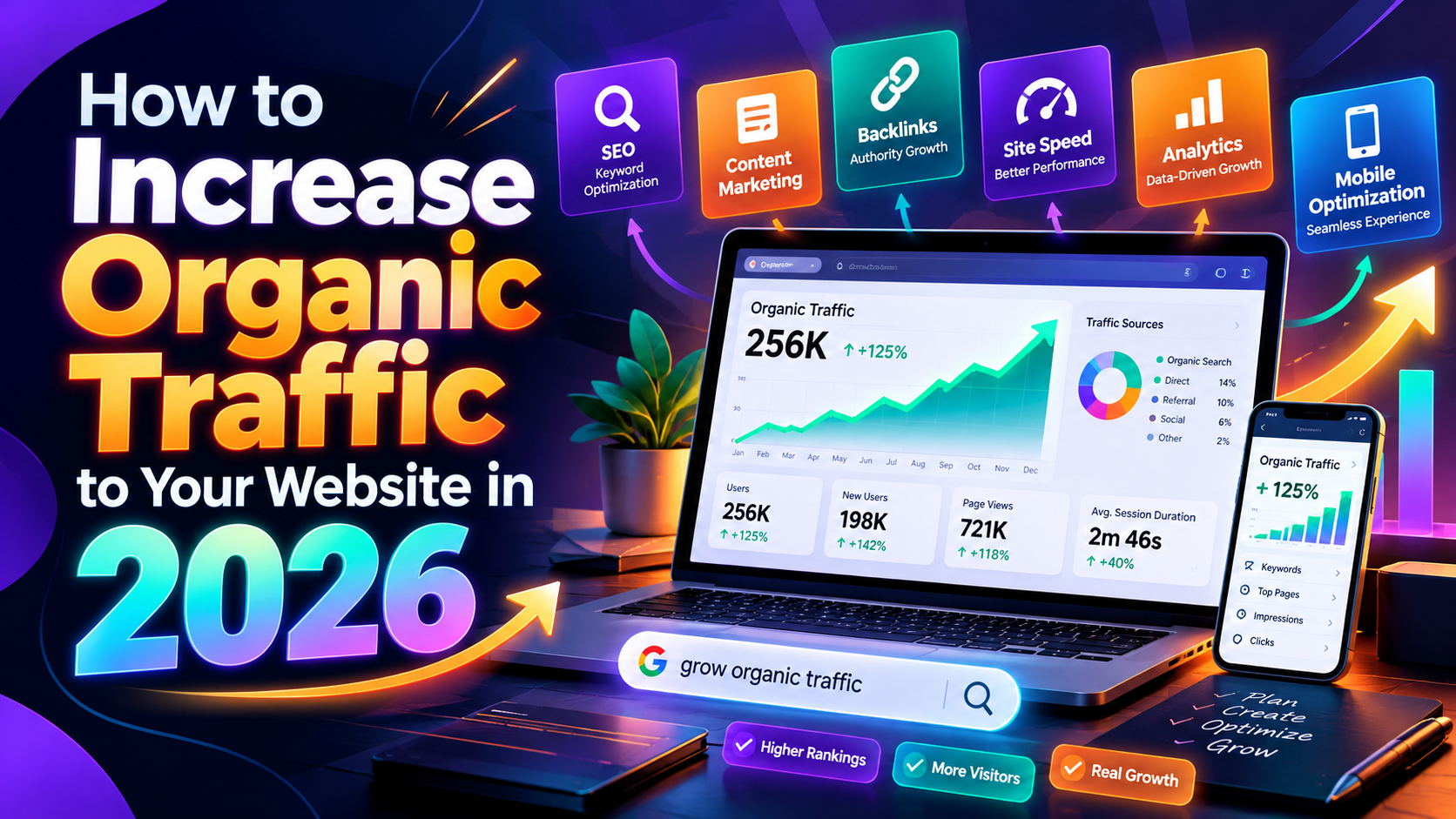
“Organic traffic refers to visitors who reach a website through unpaid search results. For businesses, consistent organic traffic can create opportunities to attract potential customers without depending entirely on paid advertising for every website visit.”
Why Organic Traffic Matters for Websites in 2026
Organic traffic refers to visitors who reach a website through unpaid search results. For businesses, consistent organic traffic can create opportunities to attract potential customers without depending entirely on paid advertising for every website visit.
Search behaviour is evolving with AI-powered search, conversational queries, and changing user expectations. Businesses therefore need to build websites that are technically accessible, useful, trustworthy, and capable of answering the questions their target customers are actually searching for.
Understand What Your Customers Search For
Increasing organic traffic starts with understanding customer search intent. Instead of choosing keywords only because they have high search volume, businesses should identify the questions, problems, services, products, and comparisons their target audience is actively looking for.
Search intent can be informational, commercial, transactional, or navigational. Creating content that matches the purpose behind a search gives visitors more relevant information and creates a stronger foundation for organic search growth.
Create Helpful Content Around Search Intent
High-quality content should answer real customer questions and provide information that helps visitors make decisions. Businesses can create detailed service pages, how-to guides, comparisons, FAQs, case studies, industry resources, and educational blog posts based on genuine customer needs.
Content should provide original value rather than simply rewriting information already available on other websites. Practical examples, business experience, expert explanations, original research, and useful insights can make pages more valuable to both readers and search engines.
Improve Your Website Technical SEO
Technical SEO helps search engines discover, crawl, understand, and index website content. Businesses should review important areas such as XML sitemaps, robots.txt, canonical URLs, redirects, HTTPS, website architecture, crawlability, mobile responsiveness, and indexation.
Technical problems can prevent valuable content from receiving organic visibility. Regular technical audits can identify broken links, duplicate pages, incorrect redirects, indexing problems, missing metadata, and other issues that may affect search performance.
Optimize Website Speed and Core Web Vitals
Website performance affects how visitors interact with pages. Large images, unnecessary scripts, excessive animations, inefficient code, and poor hosting configuration can slow down websites and create a frustrating user experience.
Businesses can improve performance by compressing images, reducing unnecessary JavaScript, optimizing CSS, using caching, improving server response times, and monitoring important page experience metrics. Performance optimization should continue as new content and functionality are added.
Make Your Website Mobile Friendly
A large amount of online activity takes place on smartphones, making mobile-friendly design essential for organic search traffic. Visitors should be able to read content, navigate pages, complete forms, and contact businesses comfortably on smaller screens.
Responsive website development should adapt layouts, images, typography, menus, and buttons to different screen sizes. Mobile usability should be tested regularly because new website updates can sometimes create problems on specific devices.
Build Strong Internal Links Between Related Pages
Internal linking helps visitors discover related information while providing search engines with context about the relationships between pages. A well-planned internal linking structure can connect service pages, blogs, FAQs, guides, and other important resources.
Businesses should use relevant descriptive anchor text and link pages naturally where the information is useful to visitors. Strong internal linking can also help distribute attention toward important commercial and informational pages throughout the website.
Develop Topic Clusters for Better Organic Visibility
Publishing individual articles around unrelated keywords can make it difficult to demonstrate depth around an important subject. Topic clusters organize content around a central subject with supporting articles that answer related questions and cover specific subtopics.
For example, a website development company can create connected content around website design, website development, website cost, SEO-friendly websites, website maintenance, AI-ready websites, AEO, GEO, and mobile development. Linking these pages creates a more useful content ecosystem.
Optimize Existing Pages Before Creating More Content
Businesses often focus on publishing new blog posts while leaving older pages untouched. Existing pages may already have search impressions, backlinks, or useful information that can be improved to increase their potential.
Content updates can include improving outdated information, adding missing sections, answering additional questions, strengthening internal links, improving titles, updating examples, and making the page more useful for the current search intent.
Optimize Pages for AEO and AI Search
Answer Engine Optimization focuses on making useful information easy to understand and directly answering questions users ask. Businesses can improve AEO readiness with question-based headings, clear answers, detailed explanations, FAQs, and well-organized information.
AI-powered search experiences can surface information in different ways from traditional search results. Strong SEO fundamentals combined with useful, structured content can help websites remain discoverable as search behaviour continues to evolve.
Use GEO Strategies for Generative Search Visibility
Generative Engine Optimization is commonly used to describe strategies intended to improve visibility within AI-generated search experiences. GEO should not replace traditional SEO because technical accessibility, useful content, authority, and search relevance remain important foundations.
Businesses can prepare by creating authoritative content, maintaining consistent brand information, answering customer questions, publishing original expertise, and developing comprehensive resources around their main services and topics.
Strengthen Local SEO for Targeted Organic Traffic
Local SEO can help businesses attract customers searching for products and services in specific cities or service areas. Accurate business information, useful location pages, customer reviews, and an optimized Google Business Profile can support local discovery.
Location pages should provide genuinely useful information instead of simply replacing the city name across duplicate pages. Businesses can include local service information, areas served, directions, customer questions, and other details that are relevant to people in that location.
Build High-Quality Backlinks and Online Authority
Relevant backlinks can help search engines discover content and understand its position within a broader online ecosystem. Businesses can earn links by publishing original research, useful guides, industry resources, case studies, tools, and information that other websites genuinely want to reference.
The objective should be earning relevant and trustworthy references rather than collecting large numbers of low-quality links. Building authority takes time and should be supported by valuable content and genuine industry expertise.
Create Content That Demonstrates Real Expertise
Businesses have an advantage when they publish information based on real experience. Project examples, customer questions, case studies, processes, lessons learned, original observations, and practical recommendations can make content more useful than generic articles.
Content should clearly communicate who is providing the information and why the business is qualified to discuss the topic. Demonstrating genuine expertise can strengthen trust with visitors while supporting a broader organic search strategy.
Improve Titles and Meta Descriptions
Page titles should clearly describe what each page is about and naturally reflect the primary search intent. Avoid stuffing several variations of the same keyword into one title because clarity is more useful than repetition.
Page titles should clearly describe what each page is about and naturally reflect the primary search intent. Avoid stuffing several variations of the same keyword into one title because clarity is more useful than repetition.
Use Images and Videos to Improve Content Quality
Relevant images, diagrams, screenshots, and videos can make complex information easier to understand. Visual content can also improve the usefulness of tutorials, product pages, service explanations, and educational resources.
Images should be properly compressed and given meaningful alternative text when appropriate. Businesses should avoid adding unnecessary visual elements simply for decoration because excessive media can negatively affect page performance.
Improve Your Website Conversion Experience
Increasing organic traffic is only one part of digital growth. A website should also make it easy for visitors to take meaningful actions such as calling, submitting an enquiry, booking an appointment, requesting a quotation, or purchasing a product.
Clear calls-to-action, simple forms, trustworthy information, easy navigation, and relevant service pages can help turn organic visitors into potential customers. Organic traffic becomes more valuable when the website provides a smooth journey from search to conversion.
Monitor Organic Traffic and Search Performance
Businesses should regularly monitor organic traffic, search queries, impressions, clicks, landing pages, conversions, and engagement metrics. These measurements can reveal which topics attract visitors and which pages need further improvement.
Search performance should be reviewed over time instead of judging results from a single day or week. Seasonal demand, algorithm changes, competition, website updates, and content changes can all influence organic traffic.
Avoid Common Organic Traffic Mistakes
Businesses can limit organic growth by publishing thin content, targeting irrelevant keywords, creating duplicate pages, ignoring technical SEO, buying poor-quality backlinks, neglecting mobile performance, or producing large volumes of generic AI-generated content.
A sustainable strategy focuses on users first. Businesses should solve real customer problems, provide accurate information, maintain technical quality, and continuously improve their most important pages instead of chasing shortcuts that promise immediate rankings.
Create a Long-Term Organic Traffic Strategy
Increasing organic traffic in 2026 requires several connected activities rather than one SEO technique. Technical SEO creates accessibility, useful content satisfies search intent, internal links establish relationships, authority improves credibility, and performance optimization creates a better user experience.
Businesses should also prepare for AI-powered search through clear content, AEO, GEO, structured information, and strong brand authority. The goal is to build a website that remains useful to customers while adapting to the changing ways people discover information online.
Increase Organic Traffic by Creating a Website People Actually Want to Visit
Organic traffic growth comes from consistently improving the complete website experience. When businesses combine useful content, technical SEO, fast performance, mobile usability, strong internal linking, local visibility, authority building, and AI-search readiness, they create a stronger foundation for sustainable organic growth.
Frequently Asked Questions About Increasing Organic Traffic
How can I increase organic traffic to my website in 2026?
Focus on search intent, helpful content, technical SEO, website speed, mobile usability, internal linking, topic clusters, local SEO, authority building, content updates, and regular search performance monitoring. AEO and GEO strategies can complement these SEO fundamentals.
How long does it take to increase organic website traffic?
There is no fixed timeline because results depend on website history, competition, content quality, authority, technical condition, search demand, and the amount of optimization performed. Organic traffic generally requires consistent improvement rather than a one-time change.
Does creating more blog posts increase organic traffic?
Not automatically. Publishing more content can create additional opportunities to attract search traffic, but quality, relevance, search intent, originality, technical SEO, and internal linking are more important than simply increasing the number of articles.
Are AEO and GEO important for organic traffic in 2026?
AEO and GEO can help businesses prepare for answer-based and generative search experiences. They should complement traditional SEO rather than replace technical optimization, useful content, authority building, and strong website architecture.
Can small businesses increase organic traffic without paid advertising?
Yes. Small businesses can build organic traffic through useful niche content, local SEO, optimized service pages, technical SEO, internal linking, genuine expertise, and consistent website improvements. Organic growth generally requires time and ongoing effort.