
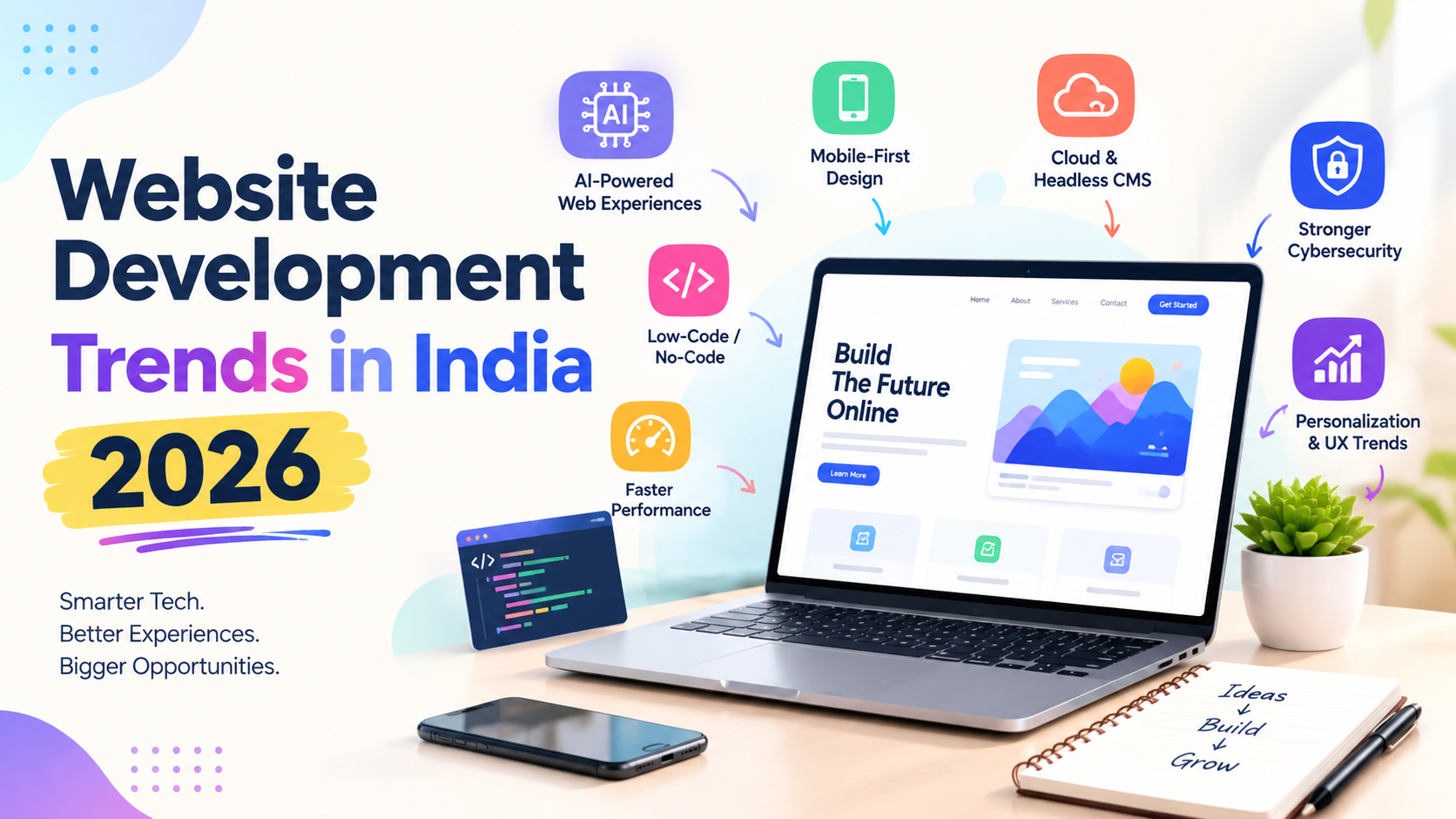
“Website development in India is moving beyond creating attractive pages with basic business information. In 2026, businesses increasingly expect websites to support customer acquisition, automation, personalization, online transactions, communication, and integration with other digital business systems. AI-assisted development, performance-focused architecture, AI search optimization, cloud-native technologies, and stronger security practices are among the developments influencing modern web projects. India’s technology sector is also seeing a broader shift toward enterprise AI and AI-native solutions.”
How Website Development Is Changing in India in 2026
Website development in India is moving beyond creating attractive pages with basic business information. In 2026, businesses increasingly expect websites to support customer acquisition, automation, personalization, online transactions, communication, and integration with other digital business systems. AI-assisted development, performance-focused architecture, AI search optimization, cloud-native technologies, and stronger security practices are among the developments influencing modern web projects. India’s technology sector is also seeing a broader shift toward enterprise AI and AI-native solutions.
This means businesses planning a new website should consider more than visual appearance. Performance, search visibility, accessibility, scalability, security, structured information, and integration capabilities can influence how effectively a website supports long-term digital growth. The right approach is not to implement every emerging technology but to select developments that solve genuine customer or operational requirements.
AI-Powered Websites Becoming More Practical
Artificial Intelligence Is Moving into Everyday Web Experiences
Artificial intelligence is becoming increasingly integrated into website development workflows and customer-facing experiences. Businesses can use AI for conversational assistance, intelligent search, product recommendations, content support, lead qualification, document processing, and selected workflow automation. AI is also influencing the development process itself, with developers using AI-assisted tools for coding, testing, documentation, debugging, and repetitive development activities. Industry analysis of 2026 web development identifies AI-native and AI-assisted development as a significant current direction.
Businesses should nevertheless introduce AI where it provides measurable value rather than adding it simply as a promotional feature. Accuracy, privacy, API expenses, security, and human review should be considered when AI systems interact with customers or business information. A successful AI-powered website combines automation with reliable conventional application architecture.
AEO and GEO Becoming Part of Website Development
Traditional SEO remains important, but websites increasingly need content that can also be understood by answer engines and generative AI systems. Answer Engine Optimization focuses on creating clear answers to relevant questions, while Generative Engine Optimization focuses on making useful information understandable and discoverable within AI-assisted search experiences. Current 2026 web-development analysis increasingly places AEO and GEO alongside conventional SEO when discussing website discoverability.
Clear heading structures, useful FAQs, descriptive service pages, structured data where appropriate, consistent business information, internal linking, and technically crawlable pages can support this broader search strategy. Businesses should still prioritize genuinely useful content rather than creating repetitive pages designed only to target AI systems.
Website Performance and Core Web Vitals
Website speed continues to be an important development priority in 2026. Businesses need pages that load efficiently and remain responsive across smartphones, tablets, laptops, and different network conditions. Performance-focused development includes optimized images, efficient code, caching, appropriate rendering strategies, reduced unnecessary JavaScript, and careful management of third-party scripts. Current 2026 development guidance continues to treat Core Web Vitals and performance as important engineering considerations.
Performance should be considered during development rather than addressed only after a website is completed. Heavy page builders, oversized media, unnecessary libraries, and excessive scripts can make optimization more difficult later. A lightweight technical foundation can improve usability while making future maintenance easier.
Mobile-First Responsive Website Development
Indian businesses serve customers using a wide range of mobile devices and screen sizes, making responsive development a fundamental requirement. Websites should provide usable navigation, readable typography, appropriately sized controls, optimized images, and layouts that adapt naturally across devices. Mobile design should not simply shrink a desktop website. Important content, enquiry actions, forms, menus, and customer journeys need to remain convenient on smaller screens.
Developers should test websites across multiple viewport sizes rather than optimizing for only one popular smartphone. Tablets and intermediate screen sizes can expose layout problems that may not appear on standard desktop or mobile previews. A consistent responsive system helps businesses provide a more reliable experience across devices.
Progressive Web Applications for App-Like Experiences
Progressive Web Applications combine web technologies with selected app-like capabilities. Depending on browser support and implementation, PWAs can provide features such as installation, caching, offline functionality, and improved repeat-use experiences. They can be useful when a business wants a web-based solution with richer application behavior without immediately maintaining completely separate experiences for every platform.
PWAs are not automatically the correct choice for every business. Requirements involving extensive native-device functionality may still justify dedicated mobile applications. Businesses should compare customer requirements, functionality, budget, maintenance, and platform capabilities before selecting between a conventional responsive website, PWA, or native application.
Modern Frameworks and Server-Side Rendering
Modern frameworks are helping development teams create websites that combine interactive interfaces with server-rendered or pre-rendered content. Technologies within ecosystems such as React and Next.js can support applications that require reusable components, dynamic functionality, API integrations, and different rendering strategies. Current 2026 development discussions also highlight meta-frameworks and server components as significant architectural directions for modern web applications.
However, the newest framework is not automatically the best technology for every project. A small informational website and a large customer platform have very different technical requirements. Developers should select architecture according to functionality, performance, maintainability, scalability, hosting requirements, and the capabilities of the team responsible for long-term support.
Cloud-Native Website and Application Development
Cloud infrastructure is becoming increasingly important for scalable web applications, APIs, databases, storage, and deployment workflows. A 2026 CNCF report estimates that India has 2.25 million cloud-native developers and reports hybrid cloud as the most common deployment model among surveyed Indian developers. This broader adoption supports businesses building applications that need flexible infrastructure, automated deployments, integrations, and the ability to scale as requirements change.
Cloud-native architecture should still be selected according to project requirements. Small websites may not need complicated distributed infrastructure, while enterprise applications can benefit from more advanced cloud capabilities. Infrastructure decisions should balance performance, reliability, security, operational complexity, and cost.
API-First Development and Connected Business Systems
Modern business websites increasingly operate as part of a larger technology ecosystem. A website may need to communicate with CRM software, ERP systems, payment gateways, mobile applications, inventory platforms, analytics tools, or customer communication services. API-first development can make these connections easier to plan by defining how different applications exchange permitted information.
APIs should be developed with authentication, authorization, validation, monitoring, and error handling in mind. Third-party integrations should also account for external platform limits and possible future changes. Well-planned integration architecture allows websites to become useful components of broader digital business operations rather than isolated marketing pages.
Cybersecurity Becoming a Website Development Priority
Security is increasingly important as websites handle customer information, authentication, payments, APIs, and connections with business systems. Secure development can include appropriate authentication, authorization, encryption, backups, dependency management, validation, monitoring, and software updates. Gartner forecasts Indian information-security spending at $3.4 billion in 2026, up 11.7% from 2025, while highlighting identity-related threats and regulatory pressures among current security concerns.
Security should therefore be included throughout website planning and development instead of being treated as a feature added immediately before launch. The exact security controls required will depend on the website’s functionality, information sensitivity, infrastructure, integrations, and applicable organizational requirements.
Personalized Website Experiences
Websites can increasingly adapt content and recommendations according to relevant user interactions, preferences, account information, or other permitted data. E-commerce stores may recommend relevant products, while service businesses can simplify customer journeys according to user requirements. AI can expand these capabilities by helping systems analyze appropriate information and deliver more contextual interactions.
Personalization should be implemented carefully because unnecessary data collection can create privacy and security concerns. Businesses should clearly understand what information is required, how it is used, and how long it needs to be retained. Useful personalization should make customer journeys easier rather than making visitors feel unnecessarily monitored.
Conversion-Focused Business Website Design
Modern business websites are increasingly evaluated according to whether visitors complete meaningful actions rather than simply how visually impressive the homepage appears. These actions can include enquiries, bookings, calls, registrations, purchases, downloads, or requests for quotations. Design decisions should therefore guide visitors naturally toward relevant information and appropriate calls to action.
Clear service descriptions, simple navigation, accessible contact information, trustworthy business details, focused landing pages, and convenient enquiry forms can support this approach. Analytics can then help businesses understand how visitors interact with these journeys and identify areas requiring improvement.
Accessibility and Inclusive Website Development
Accessible development helps websites serve people with different abilities, devices, and interaction methods. Developers should consider semantic HTML, keyboard navigation, readable typography, alternative text, sufficient contrast, clear form labels, and logical page structures. Many accessibility improvements also encourage cleaner development and more understandable content structures.
Accessibility should be considered during design and development instead of being treated only as a final checklist. Reusable accessible components can make it easier to maintain consistent experiences as websites grow and additional pages are introduced.
Headless and Composable Website Architecture
Headless architecture separates content management from the customer-facing frontend. This can allow businesses to distribute content across websites, mobile applications, and other digital channels while using a centralized content source. Composable approaches extend this idea by connecting specialized services through APIs instead of depending on one platform for every function.
These architectures can provide flexibility for suitable projects, but they also introduce additional technical and operational complexity. Traditional CMS solutions may remain more practical for straightforward business websites, while headless approaches can make more sense for organizations with multiple channels, complex integrations, or specialized frontend requirements.
How Indian Businesses Should Prepare for Website Trends
Businesses do not need to rebuild their websites every time a new development trend appears. The first priority should be identifying problems affecting customers, search visibility, performance, security, conversions, or internal operations. A technical audit can help determine whether the existing website needs optimization, selective upgrades, integration improvements, or complete redevelopment.
The strongest 2026 website strategies combine useful content, responsive design, performance, security, search visibility, maintainable technology, and carefully selected automation. Emerging technologies such as AI, cloud-native infrastructure, and advanced personalization should then be introduced where they provide a clear business or customer benefit. India’s broader technology sector is similarly moving toward enterprise-scale AI adoption rather than isolated experimentation.
Website development in 2026 is increasingly about creating fast, secure, responsive, searchable, and connected digital experiences rather than simply publishing attractive pages. Businesses in India can prepare for this shift by combining strong web-development fundamentals with AI capabilities, SEO, AEO, GEO, modern architecture, cloud technologies, and customer-focused experiences where they provide genuine value.
Frequently Asked Questions About Website Development Trends 2026
What are the important website development trends in India for 2026?
Important themes include AI-assisted development, AI-powered customer experiences, AEO and GEO, performance optimization, modern rendering architectures, cloud-native development, stronger cybersecurity, personalization, accessibility, API integrations, and responsive user experiences.
Is AI important for business websites in 2026?
AI is becoming more relevant for website development and selected customer experiences, including conversational interfaces, search, recommendations, automation, and development assistance. Businesses should implement AI when there is a clear use case and appropriate controls for accuracy, security, privacy, and cost.
Are SEO AEO and GEO all important for websites?
They address different aspects of digital discovery. SEO focuses on traditional search visibility, AEO supports clear answers to user questions, and GEO considers how content can be understood within generative AI discovery experiences. Strong technical structure and useful, credible content support all three approaches.
Should businesses redesign their websites for 2026?
Not every business requires a complete redesign. Existing websites should first be evaluated for mobile responsiveness, speed, usability, security, search visibility, content quality, accessibility, integrations, and conversion performance before deciding whether optimization or redevelopment is appropriate.