
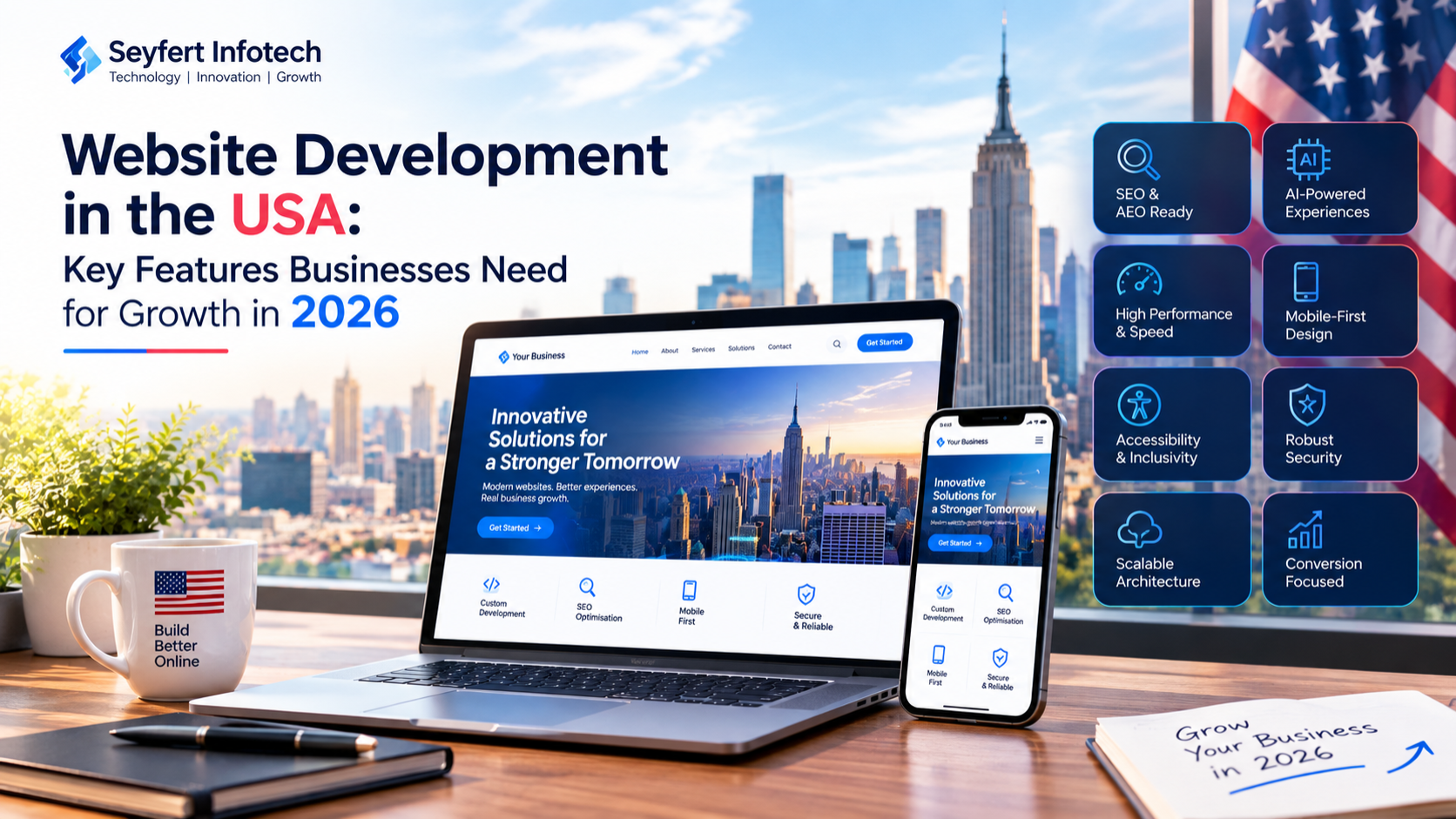
“A business website is no longer simply an online brochure. For many organisations in the USA, it is an important part of customer acquisition, brand communication, lead generation, ecommerce, customer service and digital operations. As search continues to evolve, businesses also need websites that can be understood across traditional search, AI-powered search experiences and increasingly visual discovery. A modern website should therefore combine strong design with technical performance, useful content, accessibility, security, structured information and a clear conversion strategy. For USA businesses, the objective is not simply to launch a website. It is to build a digital platform that can support customers and business growth over the long term.”
Why Website Development Matters for USA Businesses in 2026
A business website is no longer simply an online brochure. For many organisations in the USA, it is an important part of customer acquisition, brand communication, lead generation, ecommerce, customer service and digital operations. As search continues to evolve, businesses also need websites that can be understood across traditional search, AI-powered search experiences and increasingly visual discovery. A modern website should therefore combine strong design with technical performance, useful content, accessibility, security, structured information and a clear conversion strategy. For USA businesses, the objective is not simply to launch a website. It is to build a digital platform that can support customers and business growth over the long term.
What Makes a Modern Business Website Successful?
A successful business website needs to balance user experience, technology and business objectives. Visitors should be able to quickly understand what a company offers, why it matters and what action they can take next. At the same time, search engines and AI systems need clear, structured and trustworthy information to understand the organisation and its services. Important elements include: • Mobile-first design • Fast page performance • Clear navigation • Strong website security • Accessible interfaces • Search-friendly content • Structured data • AI-ready information • Conversion-focused page layouts • Scalable architecture • Analytics and continuous improvement
1. Mobile-First Website Design
A significant part of modern website usage takes place on mobile devices, making responsive design essential for businesses targeting customers across the USA. A mobile-first website should provide clear navigation, readable content, appropriately sized controls and fast-loading pages across different screen sizes. Responsive design should not simply shrink a desktop website for mobile devices. The entire experience should be planned around how users interact with the website on smartphones, tablets and desktops. A consistent experience across devices can help businesses provide a more reliable digital journey.
2. Website Performance and Core Web Vitals
Website performance affects how quickly users can access and interact with a page. Large images, inefficient scripts, unnecessary third-party resources and poorly optimised code can all affect performance. Businesses should consider image optimisation, caching, efficient code, content delivery, server performance and frontend optimisation as part of the development process. Core Web Vitals can also be used as part of a broader performance strategy to understand real-world page experience. Performance should be treated as an ongoing process rather than something checked only before launch.
3. SEO-Friendly Website Architecture
Search engine optimisation begins with the website architecture itself. Clean URLs, logical navigation, descriptive page titles, meaningful headings, internal linking, crawlable content and technically sound pages can help search engines understand a website. Each important service or product should have a clear purpose and relevant content. For businesses targeting different markets, locations or customer segments, the website architecture should also make geographic and service information easy to understand without creating unnecessary duplicate pages. SEO should therefore be considered during website planning rather than added after development.
4. AI-Ready Content and Generative Search
Search is becoming increasingly conversational and multimodal. People can discover businesses through traditional search results, AI-powered answers, image-based search and other emerging search experiences. Google has introduced reporting for generative AI features and multimodal search within Search Console, reflecting the broader evolution of how users discover information online. :contentReference[oaicite:1]{index=1} For businesses, this makes clear and useful website content increasingly important. Pages should answer real customer questions, explain services in straightforward language, provide specific business information and demonstrate expertise. The objective should not be to write content specifically for an AI system. The objective is to create genuinely useful information that can be understood by both people and search technologies.
5. Answer Engine Optimisation for Business Websites
Answer Engine Optimisation, or AEO, focuses on making information easier for answer-oriented search experiences to understand and use. AEO-friendly website content can include direct answers to common customer questions, clearly structured headings, concise explanations, comparison information, service details and relevant supporting context. For example, a website development company could clearly answer: What does website development include? How much does a business website cost? How long does website development take? What technologies can be used? How can a website support SEO? What makes a website accessible? Clear answers can improve the overall usability of the website while making important information easier to interpret.
6. Geographic Relevance for USA Businesses
A business targeting customers in the USA should communicate its geographic relevance clearly. This can include appropriate business location information, service areas, regional landing pages where genuinely useful, local business information and location-specific service content. Geographic information should be accurate and meaningful rather than added simply to repeat city or state names. For companies serving customers across multiple US locations, a structured approach can help users understand where services are available and which offerings are relevant to their area.
7. Website Accessibility
Accessibility should be part of professional website development. Accessible websites are designed so that people with different abilities can navigate, understand and interact with digital content. The W3C's WCAG 2.2 provides an international framework covering accessible web content, with principles including perceivable, operable, understandable and robust experiences. :contentReference[oaicite:2]{index=2} Practical considerations can include keyboard navigation, meaningful alternative text, appropriate colour contrast, accessible forms, readable content and clear focus states. Accessibility can also improve usability for many users beyond those with disabilities.
8. Strong Website Security
Website security is essential for businesses handling customer information, enquiries, accounts, payments or other sensitive data. A professional website should use HTTPS and appropriate access controls while keeping software, plugins and dependencies maintained. Additional security measures may include secure authentication, protected forms, input validation, secure APIs, monitoring, backups and appropriate hosting controls. Security requirements will vary depending on the type of website, industry and information being processed. Security should therefore be considered during architecture and development rather than after the website has been launched.
9. Conversion-Focused Website Design
A visually attractive website is not necessarily an effective business website. The design should guide visitors towards meaningful actions such as requesting a quote, contacting the business, booking a service, purchasing a product or starting a conversation. Clear calls to action, concise service information, trust signals, testimonials, relevant case studies and straightforward contact options can help reduce friction. Every important page should have a clear purpose and an appropriate next step.
10. AI-Powered Website Features
AI can be integrated into websites where it provides a practical business benefit. Potential applications include intelligent search, customer assistants, recommendation systems, content personalisation, automated enquiry classification and internal workflow automation. However, AI should not be added simply because it is a current technology trend. Businesses should first identify the customer or operational problem and then determine whether AI is an appropriate solution. Human oversight may also be necessary for sensitive, complex or high-impact interactions.
Build a Website That Is Ready for the Future: User Experience + Performance + SEO + AEO + GEO + Accessibility + Security + Scalability = Stronger Digital Foundation
11. Structured Data and Search Understanding
Structured data provides additional machine-readable information about webpage content. For example, Article structured data can help Google understand information such as an article's headline, image, author and publication dates. Google Search Central recommends using supported structured data where appropriate. :contentReference[oaicite:3]{index=3} For business websites, relevant structured data may help communicate information about organisations, products, services, articles and other supported entities. Structured data should accurately represent visible and relevant information on the page rather than being used to add misleading information.
12. Scalable Website Technology
A business website should be capable of evolving as the organisation grows. A company may begin with a simple corporate website and later require ecommerce, customer portals, integrations, multilingual content, business automation or custom software. Choosing an appropriate architecture during the initial development stage can make future expansion easier. Depending on requirements, businesses may use technologies such as modern JavaScript frameworks, PHP-based systems, content management systems, APIs, cloud infrastructure or custom software platforms. Technology selection should be based on the project's requirements rather than following a single technology trend.
13. Content That Builds Trust
A professional website should make it easy for visitors to understand who the business is and why they should consider its services. Useful trust-building content can include: • Company information • Service details • Case studies • Client experiences • Certifications • Industry expertise • Team information • Contact information • Business locations • Frequently asked questions The information should be specific, accurate and easy to verify. In an environment where AI can make content creation easier, authentic business information can help distinguish a company's website from generic online content.
14. Analytics and Continuous Website Improvement
Website development does not end when the website goes live. Analytics can help businesses understand how visitors discover the website, which pages receive attention, where users leave and which actions contribute to business objectives. This information can support continuous improvement. Businesses can test page layouts, calls to action, content, navigation and conversion journeys based on observed user behaviour. A website should therefore be treated as an evolving digital product rather than a one-time design project.
How Seyfert Infotech Can Help USA Businesses
Seyfert Infotech provides website development, mobile app development, digital marketing, business automation and custom software solutions for businesses looking to strengthen their digital presence. Our website development approach focuses on creating modern, responsive and scalable digital experiences aligned with business objectives. From corporate websites and service platforms to ecommerce websites and custom digital solutions, projects can be planned around user experience, performance, search visibility, security and long-term scalability. The objective is to build a website that supports the business beyond its initial launch.
Final Thoughts
Website development in 2026 is about much more than creating attractive web pages. Businesses targeting customers in the USA need digital experiences that are fast, accessible, secure, mobile-friendly and easy to understand. At the same time, websites need to communicate useful information clearly across traditional search and emerging AI-powered discovery experiences. A strong website strategy brings together UX, SEO, AEO, GEO, performance, accessibility, security, structured data and conversion optimisation. For businesses planning a new website or modernising an existing digital platform, focusing on these fundamentals can create a stronger foundation for long-term digital growth.
What is website development?
Website development is the process of planning, designing, building, testing and maintaining a website or web application. It can include frontend development, backend development, databases, APIs, integrations, security and ongoing maintenance.
How much does website development cost in the USA?
Website development costs vary depending on the project's design, number of pages, functionality, integrations, ecommerce requirements, CMS, custom development, security and maintenance requirements. A detailed project scope is normally required for an accurate estimate.
How long does it take to develop a business website?
Development time depends on the website's complexity, content, design requirements, integrations, approval process and functionality. A simple business website can require significantly less time than an ecommerce platform or custom web application.