
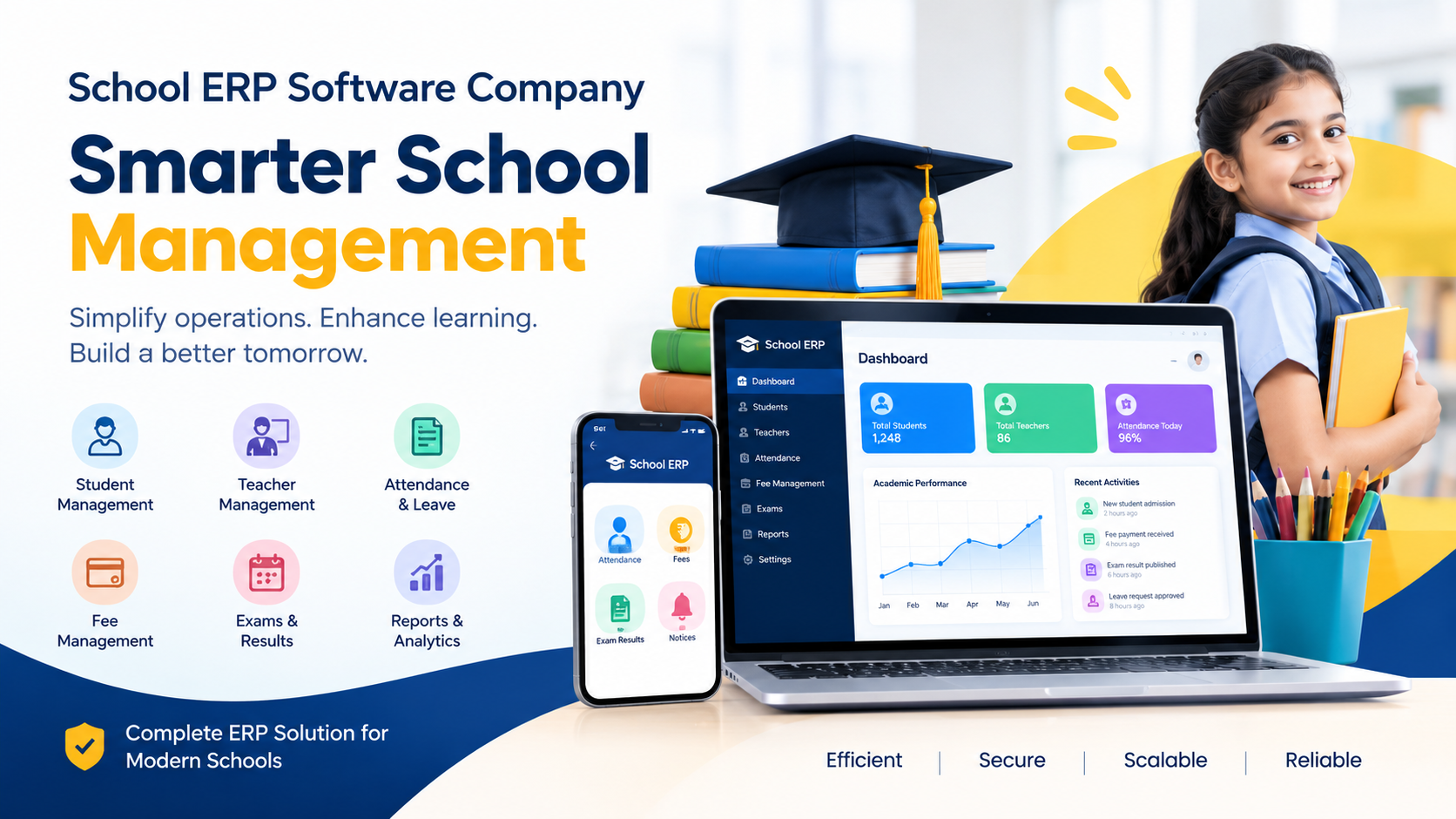
“Schools manage large amounts of academic and administrative information every day, including student records, attendance, fees, examinations, staff details, timetables, and parent communication. Managing these activities through separate registers and spreadsheets can become difficult as student numbers and administrative requirements increase. A school ERP platform brings important processes into one centralized system so authorized administrators, teachers, and management teams can access the information relevant to their responsibilities.”
Why Schools in Pondicherry Need ERP Software
Schools manage large amounts of academic and administrative information every day, including student records, attendance, fees, examinations, staff details, timetables, and parent communication. Managing these activities through separate registers and spreadsheets can become difficult as student numbers and administrative requirements increase. A school ERP platform brings important processes into one centralized system so authorized administrators, teachers, and management teams can access the information relevant to their responsibilities.
School ERP software can reduce repetitive administrative work by connecting departments and maintaining structured student records. Instead of entering similar information across multiple systems, schools can create more consistent digital workflows for everyday operations. The appropriate ERP configuration depends on the school’s size, academic structure, fee model, communication requirements, and existing administrative processes.
Complete Student Information Management System
Manage Student Records from Admission to Completion
Student information is one of the core components of school ERP software. A centralized student information system can maintain admission details, personal information, class allocation, attendance, academic records, documents, fee information, and other relevant data. Authorized staff can access appropriate information without repeatedly searching through physical files or separate spreadsheets.
Role-based access can also restrict sensitive information according to staff responsibilities. Administrators, teachers, accounts teams, and management personnel can be provided with different permissions based on operational requirements. Centralized records make it easier to maintain consistent information throughout a student’s academic journey.
School Admission Management Software
Admission periods can involve enquiries, application forms, document collection, student registration, class allocation, and fee-related processes. School ERP software can organize these activities through a structured admission management module. Digital enquiry and admission workflows can help administrative teams monitor applications and maintain relevant applicant information within a centralized platform.
Once an admission is confirmed, relevant student information can be connected with other ERP modules according to the system configuration. This reduces repeated data entry between admissions, fees, attendance, and academic administration. Schools should configure admission workflows according to their actual policies rather than adopting unnecessary steps from generic software.
Student and Staff Attendance Management
Attendance management is a daily administrative requirement for schools. ERP software can allow authorized teachers to record student attendance digitally and generate attendance information for relevant classes, periods, or reporting requirements. Depending on the selected system and integrations, attendance workflows may also support mobile applications, biometric systems, RFID devices, or other compatible technologies.
Staff attendance can also be maintained within the ERP when required. Centralized attendance records make it easier for administrators to review patterns and generate appropriate reports. Schools should select attendance methods based on practicality, infrastructure, privacy requirements, and the needs of teachers and administrators.
School Fee Management and Online Payments
Fee management can involve different fee structures, installments, concessions, transport charges, outstanding balances, receipts, and payment records. A configurable school ERP can organize these processes and provide accounts teams with centralized fee information. Modern Indian school ERP platforms commonly include fee management among their core modules, with some systems also supporting online payment workflows.
Payment integration can be added through compatible providers when schools require online collection options. The exact payment methods, transaction charges, settlement processes, and reconciliation features depend on the selected payment provider and ERP configuration. Schools should test their actual fee structures during implementation because fee rules can vary considerably between institutions.
Examination and Report Card Management
Examination management requires schools to organize subjects, schedules, marks, grades, results, and report cards. ERP software can provide teachers and administrators with structured workflows for entering academic information and generating appropriate reports. Indian school ERP systems commonly include examination and report-card management as important modules alongside attendance and fees.
The system should be configured according to the school’s actual academic and assessment structure. Different schools may follow different grading systems, subject combinations, evaluation methods, and report-card formats. Testing these requirements before full deployment can reduce additional manual work during examination periods.
Timetable and Academic Management Solutions
Creating and maintaining class timetables requires coordination between subjects, teachers, classrooms, periods, and academic schedules. School ERP software can provide structured tools for managing timetable information and communicating schedules to relevant users. Changes can be managed centrally instead of maintaining multiple independent timetable documents across different departments.
Academic modules can also support information such as subjects, classes, sections, homework, assignments, or other activities depending on the ERP requirements. Schools should prioritize features that teachers will actually use regularly rather than implementing large numbers of modules without a clear workflow.
Parent Communication and School Mobile Applications
Parents frequently need information about attendance, fees, examinations, notices, homework, and school activities. A school ERP can centralize appropriate communication instead of relying entirely on separate messages, printed circulars, and disconnected communication channels. Parent applications and communication modules are now common considerations when Indian schools evaluate ERP platforms.
Depending on the platform, schools can provide notifications, circulars, fee information, academic updates, and other approved information through web or mobile interfaces. Communication features should remain simple and organized so parents can locate important information without navigating unnecessary complexity.
Teacher and Staff Management Software
School ERP software can maintain staff profiles, departments, designations, attendance, leave information, and other administrative records according to institutional requirements. Some implementations can also include payroll or related HR workflows. Centralizing staff information can reduce dependency on separate administrative files while providing management with a structured view of employee records.
Access permissions are particularly important because HR and payroll information can contain sensitive data. Employees should only have access to information and functionality required for their responsibilities. Schools should therefore evaluate both functionality and security when selecting staff management modules.
Transport and School Bus Management
Schools operating transportation services may need to manage routes, stops, vehicles, student allocations, and related transport information. School ERP platforms can include transport modules that connect relevant student records with transportation administration. Transport management is among the modules commonly available in comprehensive Indian school ERP platforms.
Additional features such as GPS connectivity depend on the ERP system, vehicle tracking provider, hardware, and integration capabilities. Schools should select transport functionality according to their actual operational requirements instead of assuming every available technology is necessary.
Library and Inventory Management for Schools
Library management modules can organize books, student borrowing, issue and return activities, and other library records. Inventory functionality can similarly help schools maintain information about selected assets, equipment, supplies, and institutional resources. Integrating these functions with the wider ERP can reduce the need for separate administrative databases.
The exact features required depend on the size and operations of the institution. Smaller schools may need straightforward library and inventory functions, while larger campuses may require additional controls and reporting. A modular ERP allows schools to introduce functionality according to genuine administrative needs.
Cloud-Based School ERP Software in Pondicherry
Cloud-based school ERP solutions allow authorized users to access the system through supported internet-connected devices without depending entirely on software installed on a single office computer. Cloud delivery has become a common model for school ERP products in India. This can support administrators, management teams, teachers, and other permitted users who require access from different areas of the campus or approved remote locations.
Cloud implementation should still include appropriate security controls, backups, authentication, permissions, and monitoring. Schools should also consider internet reliability and operational requirements when planning deployment. Technology architecture should ultimately support the institution’s workflow rather than creating additional administrative complexity.
School ERP Data Security and User Access
School systems can contain personal and academic information about students, parents, and employees. Security and privacy should therefore be important considerations when selecting and developing ERP software. Role-based access, secure authentication, encrypted communication, backups, activity monitoring, and appropriate administrative controls can contribute to a stronger security framework.
Schools should clearly define who can access different types of information and review permissions when staff responsibilities change. Security should be considered throughout software development, deployment, integration, and maintenance instead of being treated as a one-time configuration.
Custom School ERP Software Development in Pondicherry
Not every school follows the same administrative and academic workflow. Custom ERP development can allow an institution to configure modules, user roles, reports, fee structures, communication processes, and integrations around its own requirements. Before development begins, the software team should understand existing processes and identify which workflows genuinely need digitization or automation.
Custom software can also provide flexibility when schools need integration with existing websites, mobile applications, payment systems, attendance devices, or other compatible platforms. A scalable architecture makes it easier to introduce additional functionality as student numbers and institutional requirements change.
How to Choose a School ERP Software Company in Pondicherry
Schools should evaluate ERP providers based on functionality, usability, security, implementation support, data migration, training, integrations, and long-term maintenance. The system should be demonstrated using realistic school workflows rather than only generic sample information. In particular, schools should verify that fee structures, attendance processes, examination formats, and parent communication match their actual requirements because these are among the modules most frequently used in school operations.
Administrators should also consider how existing student information will be migrated into the new platform and how teachers and office staff will be trained. A successful ERP implementation depends not only on software features but also on accurate data, practical workflows, user adoption, and ongoing technical support.
School ERP software can bring admissions, student information, attendance, fees, examinations, staff management, parent communication, transport, and reporting into a more connected digital environment. A customized ERP solution can help schools in Pondicherry modernize everyday administration while providing a scalable platform that can evolve with future academic and operational requirements.
Frequently Asked Questions About School ERP Software
What is school ERP software?
School ERP software is a centralized digital platform for managing academic and administrative activities such as admissions, student information, attendance, fees, examinations, timetables, staff records, transport, and parent communication.
Can school ERP software manage online fee payments?
Yes, an ERP can support online fee collection when integrated with compatible payment services. Available payment methods, transaction costs, reconciliation, and other capabilities depend on the ERP and payment provider.
Can parents access school ERP information through mobile apps?
Yes. School ERP systems can provide parent-facing mobile or web access for information such as attendance, fees, notices, academic updates, and other approved school communication. Parent applications are a common feature of current Indian school ERP products.
Can school ERP software be customized?
Yes. Custom school ERP software can be developed around specific admission processes, fee structures, academic workflows, user roles, reports, integrations, and administrative requirements.